

Chuadanga farmers prepare 2.7 lakh date palm trees for molasses season

- আপডেট : শনিবার, ৮ নভেম্বর, ২০২৫
- ৪০ বার দেখা হয়েছে
District Desk
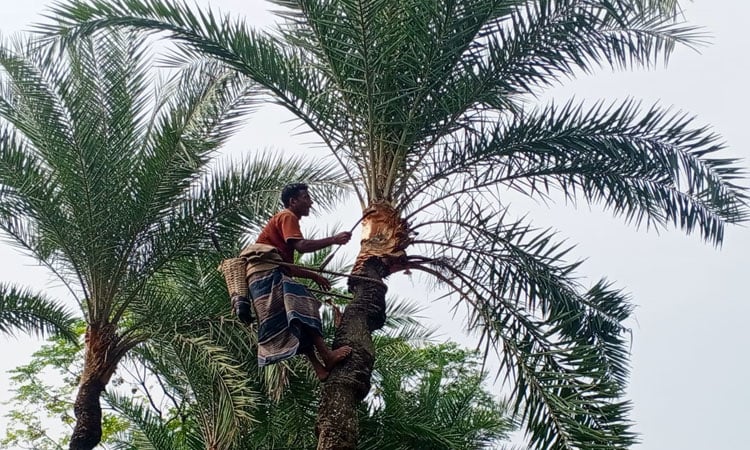
As autumn gradually gives way to winter, farmers across Chuadanga district have begun preparing approximately 2.7 lakh date palm trees for the upcoming date sap collection season — a period that marks the beginning of traditional molasses (jaggery) production, one of rural Bengal’s most beloved winter customs.
The soft sunlight, dew-soaked mornings, and light fog now hanging in the air signal the approach of the season of date sap and jaggery, a time that plays a vital role in the local rural economy.
Across the district’s four upazilas, farmers are seen trimming, cleaning, and preparing the trees for tapping. After drying the trees and setting up bamboo canes during the month of Kartik, preparations for sap collection are now at their peak. According to officials, around 10,000 to 15,000 farmers are involved in this traditional seasonal occupation.
The Department of Agricultural Extension (DAE) reports that Chuadanga currently has 271,960 date palm trees. Each tree typically produces 10 to 12 kilograms of molasses, with the department setting a target of 2,500 metric tons for the current season.
Local sources said the onset of winter in rural areas is customarily marked by the extraction of date sap. Farmers are now pruning and cleaning the trees, and sap collection is expected to begin within a few weeks as the temperature drops further. In areas with large concentrations of date palms, temporary work stations have already been established, and branches are being dried to be used as fuel during molasses production.
Shahin Ali, a grower from Satghari village in Chuadanga municipality, said, “We have started pruning and cleaning about 120 trees. Installation of the drains will begin within two weeks. Once pruned, a tree yields sap for three to four days before it must be dried again. As winter deepens, we will collect more sap and continue producing jaggery throughout the month of Falgun.”
Another farmer, Asadul Hossain from Gopinathpur village, said, “I have prepared 40 trees this year. In about ten days, we will begin installing the drains, and sap collection should start by the last week of November. I expect to produce around 10 to 12 kilograms of jaggery per tree.”
Similarly, Delwar Hossain of Dhuturhat village said he has already finished preparing 140 trees. “We will start collecting sap from the beginning of Agrahayan. If the winter is long and cold, molasses production will be good this year. We usually sell our jaggery at Sarojganj market,” he added.
Sarojganj Bazar, the most prominent molasses market in Chuadanga, is also preparing for the season. Farmers from different upazilas bring their products to this market, which is widely known for selling pure and high-quality molasses. Last year, molasses sold for Tk 220–280 per kilogram, while patali (solid jaggery) fetched around Tk 300 per kilogram.
Masudur Rahman Sarkar, Deputy Director of the Department of Agricultural Extension, said the district achieved its production target last year and expects a similar outcome this season. “If the intensity of winter increases, farmers will be able to produce better-quality molasses,” he noted.
He also advised farmers to protect the sap from birds and bats to maintain hygiene and ensure purity during production. Additionally, he urged them to avoid using any substances that could lead to adulteration in jaggery preparation.
With favorable weather conditions and the continued dedication of local farmers, Chuadanga’s traditional date molasses season is set to bring both sweetness and economic benefit to the region once again.












প্রধান সম্পাদক: রাশিদুল হাসান বুলবুল, নির্বাহী সম্পাদক: নূরুল মোমেন খান চৌধুরী (রুমী),
দেশ মিডিয়া ওয়ানবিডি লিঃ এর পক্ষে- মোছাঃ হুসনা খাতুন কর্তৃক : ক-৪২/ (২য় তলা), বারিধারা, ঢাকা থেকে প্রকাশিত এবং মেসার্স ঝরনা প্রিন্টার্স, ১৭০ ফকিরাপুল, মতিঝিল, ঢাকা থেকে মুদ্রিত:
ফোন: ৮৪১৮১৪৪, মোবাইল: ০১৭৫৯৫১৬৭১৬, ০১৭৩৬৬১১৮১১,
E-mail: deshmedia1@gmail.com , Web: deshmediabd.com